Throughout geometry studies, which deal with various structures and shapes, you are required to calculate areas and perimeters. Each shape or structure has a different formula through which you can answer the question and calculate the area. Fortunately, there is one formula that can be applied to all triangles, and it can be used to calculate the area of a triangle using trigonometry.
Triangle Area Using Trigonometry Practice Problems
Master calculating triangle area with trigonometry formulas through step-by-step practice problems. Perfect for geometry students learning sin, cos, tan applications.
📚Master Triangle Area Calculations with Trigonometry
- Apply the formula Area = (1/2)ab sin(C) to find triangle areas
- Calculate areas using two sides and included angle measurements
- Work with degrees and radians in trigonometric area calculations
- Solve real-world problems involving triangle area using trigonometry
- Practice with right triangles, isosceles triangles, and scalene triangles
- Convert between different angle measurements for accurate calculations
Understanding Area of a Triangle
Complete explanation with examples
How to calculate the area of a triangle using trigonometry?
In the field of mathematics, emphasis is also placed on trigonometry, which deals with the study of triangles, their angles, and sides. Every student is required to demonstrate knowledge of triangles (from right triangles to isosceles triangles), and thus also answer the question of how to calculate the area of a triangle using trigonometry.
One formula for all different triangles
Now that you know the formula for calculating the area of a triangle using trigonometry, you can use it in any question where you need to calculate areas in triangles. The formula for calculating the triangle:

Practice Area of a Triangle
Test your knowledge with 27 quizzes
Calculate the area of the triangle below, if possible.
Examples with solutions for Area of a Triangle
Step-by-step solutions included
Exercise #1
What is the area of the given triangle?
Step-by-Step Solution
This question is a bit confusing. We need start by identifying which parts of the data are relevant to us.
Remember the formula for the area of a triangle:
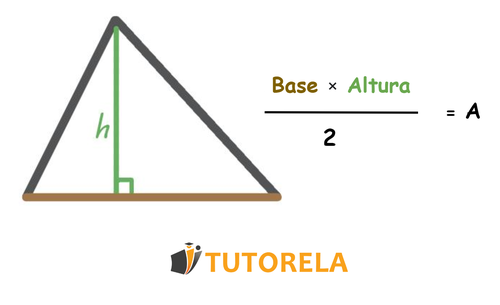 The height is a straight line that comes out of an angle and forms a right angle with the opposite side.
In the drawing we have a height of 6.
It goes down to the opposite side whose length is 5.
And therefore, these are the data points that we will use.
We replace in the formula:
Answer:
15
Video Solution
Exercise #2
What is the area of the triangle in the drawing?
Step-by-Step Solution
First, we will identify the data points we need to be able to find the area of the triangle.
the formula for the area of the triangle: height*opposite side / 2
Since it is a right triangle, we know that the straight sides are actually also the heights between each other, that is, the side that measures 5 and the side that measures 7.
We multiply the legs and divide by 2
Answer:
17.5
Video Solution
Exercise #3
The triangle ABC is given below.
AC = 10 cm
AD = 3 cm
BC = 11.6 cm
What is the area of the triangle?
Step-by-Step Solution
The triangle we are looking at is the large triangle - ABC
The triangle is formed by three sides AB, BC, and CA.
Now let's remember what we need for the calculation of a triangular area:
(side x the height that descends from the side)/2
Therefore, the first thing we must find is a suitable height and side.
We are given the side AC, but there is no descending height, so it is not useful to us.
The side AB is not given,
And so we are left with the side BC, which is given.
From the side BC descends the height AD (the two form a 90-degree angle).
It can be argued that BC is also a height, but if we delve deeper it seems that CD can be a height in the triangle ADC,
and BD is a height in the triangle ADB (both are the sides of a right triangle, therefore they are the height and the side).
As we do not know if the triangle is isosceles or not, it is also not possible to know if CD=DB, or what their ratio is, and this theory fails.
Let's remember again the formula for triangular area and replace the data we have in the formula:
(side* the height that descends from the side)/2
Now we replace the existing data in this formula:
Answer:
17.4
Video Solution
Exercise #4
Calculate the area of the triangle using the data in the figure below.
Step-by-Step Solution
To solve for the area of a triangle when the base and height are given, we'll use the formula:
Given:
Base = units
Height = units
Apply the formula:
Thus, the area of the triangle is square units.
Answer:
14
Video Solution
Exercise #5
Calculate the area of the triangle using the data in the figure below.
Step-by-Step Solution
To find the area of the given triangle, we will follow these steps:
- Step 1: Identify the given base and height from the problem.
- Step 2: Apply the formula for the area of a triangle.
- Step 3: Calculate the area by substituting the values into the formula.
Let's work through the problem:
Step 1: The base of the triangle is given as 8 units, and the height is 6 units.
Step 2: The formula for the area of a triangle is:
Step 3: Substitute the given values into the formula:
Perform the multiplication:
Therefore, the area of the triangle is square units.
Answer:
24
Video Solution
Frequently Asked Questions
What is the trigonometric formula for triangle area?
+The trigonometric formula for triangle area is Area = (1/2)ab sin(C), where 'a' and 'b' are two sides of the triangle and 'C' is the included angle between them. This formula works for all types of triangles.
How do you calculate triangle area when given two sides and an angle?
+To calculate triangle area with two sides and an angle: 1) Identify the two given sides (a and b), 2) Find the included angle (C) between these sides, 3) Apply the formula Area = (1/2)ab sin(C), 4) Calculate sin(C) using your calculator, 5) Multiply and divide by 2 for the final answer.
Why use trigonometry instead of base times height for triangle area?
+Trigonometry is used when you don't know the height of the triangle directly. The formula Area = (1/2)ab sin(C) allows you to find area using only two sides and the included angle, which is often more practical in real-world problems.
What angle should I use in the trigonometric area formula?
+Always use the included angle - the angle that lies between the two given sides. If you have sides AB and AC, use angle A (the angle at vertex A). Using the wrong angle will give an incorrect result.
Does the trigonometric area formula work for all triangle types?
+Yes, the formula Area = (1/2)ab sin(C) works for all triangles: right triangles, isosceles triangles, scalene triangles, acute triangles, and obtuse triangles. It's a universal formula for triangle area calculation.
How do I convert degrees to use in trigonometric calculations?
+Most calculators handle degrees directly - just ensure your calculator is in degree mode. If working with radians, multiply degrees by π/180. For example, 60° = 60 × π/180 = π/3 radians.
What if I get a negative result using the trigonometric area formula?
+Area cannot be negative. If you get a negative result, check that: 1) You're using the correct included angle, 2) Your calculator is in the right mode (degrees/radians), 3) You've identified the correct sides. The sine of any angle in a triangle is always positive.
Can I use this formula if I only know one side of the triangle?
+No, you need at least two sides and the included angle to use Area = (1/2)ab sin(C). If you only have one side, you'll need additional information like another side, another angle, or the triangle's height to calculate the area.