Which best describes the function below?
Linear Function y=mx+b: Understanding the concept of slope
Question 1
Which best describes the function below?
\( y=2-3x \)
Question 2
A linear function has a slope of -3 and passes through the point \( (-6,-3) \).
Choose the equation that represents the function.
Question 3
A linear function with a slope of 6 passes through the point \( (1,1) \).
Which equation represents the function?
Question 4
A linear function has a slope of 1 and passes through the point \( (6,13) \).
Choose the equation that represents this function.
Question 5
A linear function with a slope of 6 passes through the point \( (1,-4) \).
Which equation represents the function?
Examples with solutions for Linear Function y=mx+b: Understanding the concept of slope
Exercise #1
Video Solution
Step-by-Step Solution
To determine the characteristic of the function , we will evaluate the slope:
- The given function is in the form , which indicates a linear equation. Here, can be rearranged as , showing that .
- The slope is .
- In a linear function, the sign of the slope determines the function's behavior:
- If the slope is positive (), the function is increasing.
- If the slope is negative (), the function is decreasing.
- If the slope , the function is constant.
- Since , which is negative, we conclude that the function is decreasing.
Therefore, the function described by is decreasing.
Answer
The function is decreasing.
Exercise #2
A linear function has a slope of -3 and passes through the point .
Choose the equation that represents the function.
Video Solution
Step-by-Step Solution
To determine the equation of the given linear function, follow these steps:
- Step 1: Identify the key information: the slope and the point .
- Step 2: Use the point-slope form, .
- Step 3: Substitute the values , , and into the formula.
- Step 4: Solve for to convert to slope-intercept form .
Now, let's go through the process:
Use the point-slope form:
Simplify the equation:
Distribute the slope on the right side:
Subtract 3 from both sides to solve for :
which simplifies to:
This equation, , matches the first choice in the provided options.
Therefore, the equation that represents the function is .
Answer
Exercise #3
A linear function with a slope of 6 passes through the point .
Which equation represents the function?
Video Solution
Step-by-Step Solution
To solve the problem of finding the equation of the linear function, we will use the point-slope form, which is:
Step-by-step:
Step 1: Identify given information: The slope and the point .
Step 2: Substitute the slope and point into the point-slope form:
Step 3: Simplify the equation:
Step 4: Solve for to express in slope-intercept form :
Step 5: Simplify the right-hand side:
Thus, the equation of the linear function is .
Answer
Exercise #4
A linear function has a slope of 1 and passes through the point .
Choose the equation that represents this function.
Video Solution
Step-by-Step Solution
To solve this problem, we'll follow these steps:
Step 1: Use the point-slope form with the given point and slope.
Step 2: Simplify the equation to slope-intercept form.
Step 3: Identify the correct equation from the options.
Now, let's work through each step:
Step 1: Apply the point-slope form formula:
Given the point and the slope , the point-slope form is:
Step 2: Simplify to get the equation in slope-intercept form:
Step 3: Compare to find the correct answer:
From the simplified equation , the correct choice is:
Therefore, the equation representing the function is .
Answer
Exercise #5
A linear function with a slope of 6 passes through the point .
Which equation represents the function?
Video Solution
Step-by-Step Solution
To solve the problem, we will determine the equation of a line using the point-slope form. The general formula for a line in point-slope form is:
Given the slope and the point , we can substitute these values into the formula:
Simplifying the equation, we get:
Now, we want to express this in slope-intercept form . So, we solve for :
Finally, combining like terms gives us the equation:
Therefore, the equation that represents the function is .
The correct answer choice is:
Answer
Question 1
A linear function with a slope of 5 passes through the point \( (2,4) \).
Choose the equation that represents this function.
Question 2
What is the slope of a straight line that passed through the points \( (0,4),(-5,6) \)?
Question 3
Calculate the slope of the line that passes through the points \( (4,1),(2,5) \).
Question 4
Calculate the slope of a straight line that passes through the points \( (-6,1),(2,4) \).
Question 5
What is the slope of a straight line that passes through the points \( (0,0),(-8,2) \)?
Exercise #6
A linear function with a slope of 5 passes through the point .
Choose the equation that represents this function.
Video Solution
Step-by-Step Solution
To solve for the equation of a line given a slope and a point:
- Step 1: Use the point-slope form of the linear equation: .
- Step 2: Substitute the given slope and point into the equation.
- Step 3: Simplify and rearrange to convert into slope-intercept form .
Substituting into the point-slope form, we have:
Distribute the 5 across the terms in the parentheses:
Add 4 to both sides to solve for :
This simplifies to:
Therefore, the equation of the line is .
The correct choice among the options given is .
Answer
Exercise #7
What is the slope of a straight line that passed through the points ?
Video Solution
Step-by-Step Solution
To solve this problem, we'll follow these steps:
- Step 1: Identify the given information about the points.
- Step 2: Use the slope formula to find the slope.
- Step 3: Calculate and simplify.
Now, let's compute the slope:
Step 1: The points given are and .
Step 2: Apply the slope formula:
The slope is given by:
Substitute the known values:
Step 3: Simplify the expression:
Thus, the slope of the line passing through the points and is .
Therefore, the solution to the problem is .
Answer
Exercise #8
Calculate the slope of the line that passes through the points .
Video Solution
Step-by-Step Solution
Remember the formula for calculating a slope using points:
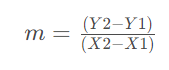
Now, replace the data in the formula with our own:
Answer
-2
Exercise #9
Calculate the slope of a straight line that passes through the points .
Video Solution
Step-by-Step Solution
To solve this problem, we'll follow these steps:
Step 1: Identify the coordinates of the given points.
Step 2: Substitute these values into the slope formula.
Step 3: Simplify to find the slope.
Now, let's work through each step:
Step 1: Given points are and . Thus, we have:
, .
Step 2: Apply the slope formula:
Step 3: Simplify:
Calculate the numerator: .
Calculate the denominator: .
Thus, the slope is:
Therefore, the solution to the problem is .
Answer
Exercise #10
What is the slope of a straight line that passes through the points ?
Video Solution
Step-by-Step Solution
To solve the problem, remember the formula to find the slope using two points
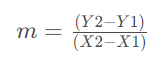
Now, we replace the given points in the calculation: